


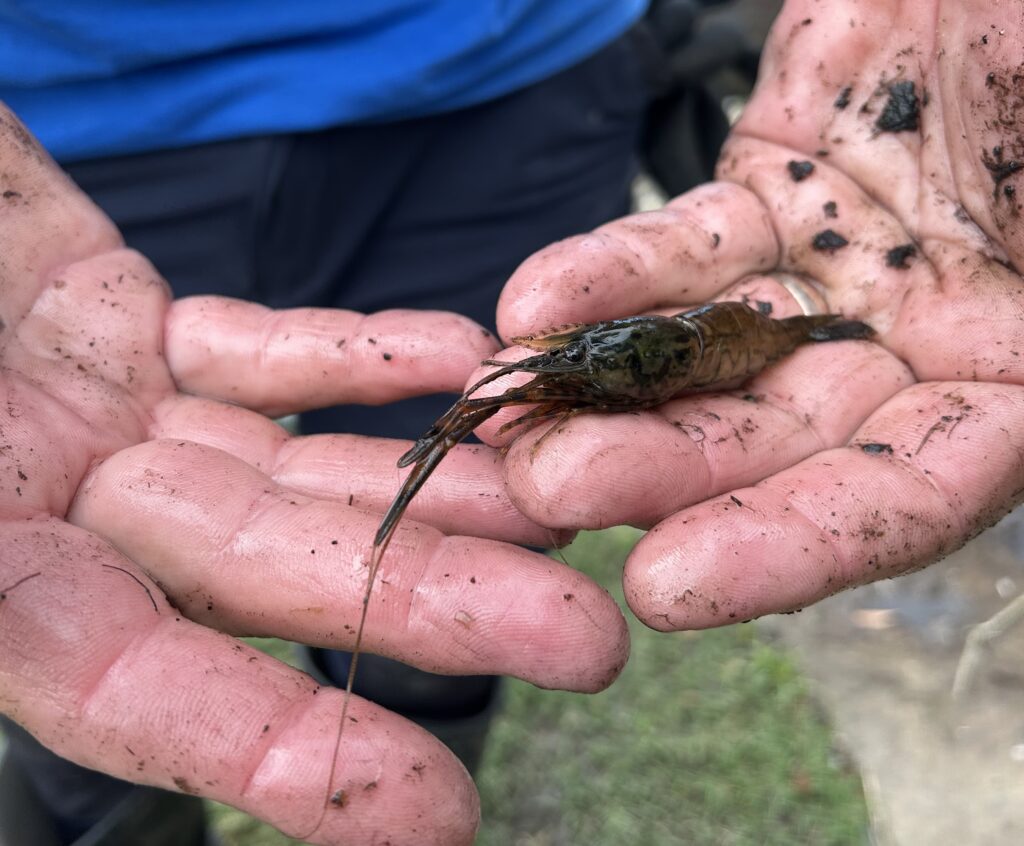
You never quite know what you’re going to discover beneath the surface of a pond!
During a recent Pond Works maintenance visit to a school pond ecosystem, our team made an unexpected discovery hiding amongst the rocks and plants – a long-armed freshwater shrimp.
It certainly wasn’t something we see every day!
nature anFinding unexpected aquatic life in a school pond is particularly fascinating because these ponds can provide students with a real-world opportunity to observe d learn about aquatic ecosystem.
But our discovery also left us with one big question:
How did a freshwater shrimp end up living in this pond?
The honest answer is that we don’t know.
And that’s what makes this little discovery so interesting.
What is a long-armed shrimp?
Long-armed shrimp are freshwater crustaceans belonging to the Macrobrachium group. Several species occur in Australia and can be found in freshwater environments such as rivers, streams and other waterways.
As their name suggests, one of their most distinctive features is their long front arms, along with their long antennae.
They can be surprisingly difficult to spot because they spend much of their time amongst rocks, plants and other sheltered areas.
So it’s quite possible for one to be living in a pond without anyone realising it’s there.
How did it get into the school pond?
This is the part we’re stick trying to work out.
Because we discovered it during a routine pond maintenance visit, we know it was already living in the pond when we arrived.
But how it got there is anyone’s guess.
There are several possibilities.
It could have made its own way into the pond somehow. It may have arrived with aquatic plants or other material introduced into the pond. Or perhaps someone deliberately put it there.
We simply don’t know.
And we’re not going to make up an answer!
Sometimes a pond throws up a mystery that even we can’t solve.
What do long-armed shrimp eat?
Freshwater shrimp are generally opportunistic feeders. Depending on the species, they can consume algae, organic material, plant matter and small aquatic organisms.
Some species are also scavengers, making use of food and organic material available within their environment.
However, there can be considerable differences between species, particularly when it comes to their size and feeding behaviour.
Some larger Macrobrachium species can be predatory and may feed on smaller aquatic animals.
That’s why identifying a freshwater shrimp before deliberately introducing one into a pond is important.
Can freshwater shrimp live in a school pond?
Some species of freshwater shrimp can live in suitable pond environments.
A well-established pond can provide plenty of shelter amongst rocks, plants and other structures, along with food sources and places to hide.
But that doesn’t mean every freshwater shrimp is suitable for every pond.
If you discover an unfamiliar shrimp or other aquatic creature, our advice is simple:
Take a photo and identify it before deciding what to do with it.
This is particularly important if the pond contains fish or other aquatic animals.
What about yabbies and freshwater crayfish?
Finding a freshwater shrimp in a pond is one thing. Deliberately adding yabbies or freshwater crayfish is another.
Yabbies are burrowing animals and can dig into soil and substrate around ponds. In a constructed pond, this behaviour can potentially cause problems, particularly where a flexible pond liner is used.
Their burrowing activity can potentially damage, disturb or undermine a pond liner, especially if they establish burrows around the edges of the pond.
They can also interact with aquatic plants and other pond inhabitants.
For these reasons, we generally wouldn’t recommend deliberately introducing yabbies or freshwater crayfish into a lined ornamental pond without first understanding the species and the potential impact on the pond.
Not every creature that can live in water makes a good pond resident!
It’s always worth considering an animal’s natural behaviour before introducing it into a contracted pond. What works perfectly well in a natural creek, river or wetland isn’t necessarily suitable for a garden or school pond.
An unexpected discovery in a school pond ecosystem
This is one of the things we love about school pond ecosystems.
A pond can become a living classroom.
Students can observe fish, aquatic plants, frogs, insects and other wildlife, and see how all these different parts interact over time.
And while the pond may have been designed and constructed with particular plants, fish and features in mind, nature has a way of adding a few surprises of its own.
Our long-armed shrimp was one of those surprises.
We don’t know how it arrived, but discovering it gave us another opportunity to look closely at the life that exists beneath the surface.
What else might be living in the pond?
When we’re carrying out pond maintenance, we’re usually focused on keeping the point and its equipment working properly by checking pumps and filtration, removing debris, managing plants and keeping the pond looking its best.
But we’re also looking at what’s happening within the ecosystem.
Ponds can provide habitat for
- Frogs
- Dragonflies and their larvae
- Aquatic insects
- Native wildlife
- Small crustaceans
- Microorganisms
- Fish and other aquatic life
Some creatures may have been deliberately introduced.
Others may arrive naturally.
And occasionally, something turns up that leaves everyone wondering:
“Where did that come from?”
A pond is more than just water and fish
A school pond ecosystem is much more than a decorative water feature.
When water, plants, rocks, fish, microorganisms and other aquatic life interact, the pond becomes a constantly changing living environment.
That’s one of the reasons we love working with ponds in educational settings.
They provide an opportunity to connect students with nature in a way that can’t always be replicated in a classroom.
And sometimes, the pond provides its own lesson.
In this case, it was a lesson in freshwater shrimp!
So where did our shrimp come from?
It may have arrived naturally.
It may have hitched a ride with an aquatic plant or other material.
It may have been deliberately introduced.
We just don’t know.
What we do know is that a fascinating discovery during an otherwise routine pond maintenance visit.
And it’s a great reminder that you never quite know what you’ll discover beneath the surface of a pond, particularly one that has developed into its own little ecosystem.
Have you found something unusual in your pond?
If you discover a creature you don’t recognise, take a photograph before disturbing it.
A photo can be incredibly useful for identifying what you’ve found and determining whether it belongs in your pond.
You might just have an interesting piece of pond wildlife living right under your nose!
At Pond Works, we design, build and maintain ponds and water features across South East Queensland, including educational pond ecosystems designed to encourage students to connect with nature and learn about aquatic environments.
And occasionally, we get to meet some unexpected residents along the way.
Because when it comes to ponds, there’s always something happening beneath the surface.
Frequently Asked Questions
What is a long-armed shrimp?
A long-armed shrimp is a freshwater crustacean belonging to the Macrobrachium group. They are recognised by their long front arms and long antennae, and several species occur in Australia.
Can a long-armed shrimp live in a pond?
Some freshwater shrimp can live in a suitable pond environments, where they have access to food, shelter and appropriate water conditions.
How do shrimp get into ponds?
There are several possibilities. They may arrive naturally, potentially be introduced with aquatic plants or other material, or be deliberately placed in a pond. In our case, we’re not sure how this particular shrimp got there!
Are yabbies good for garden or school ponds?
Yabbies are not generally something we’d recommend deliberately adding to a lined ornamental or school pond. Their natural burrowing behaviour can potentially damage or undermine a flexible pond line, particularly around pond edges.
Can yabbies damage a pond liner?
They can. Because yabbies burrow, their activity can potentially disturb, damage or undermine pond liners. This is one reason their natural behaviour needs to be considered before introducing them into a constructed pond.
Why are school pond ecosystems valuable?
School pond ecosystems can provide students with a hands-on opportunity to observe aquatic plants, fish, insects, frogs and other wildlife. They can become living learning environments that demonstrate how different parts of an ecosystem interact.
Should I put freshwater shrimp in my pond?
It’s best to identify the species first and understand its behaviour and compatibility with the existing fish and other aquatic life before deliberately introducing freshwater shrimp.